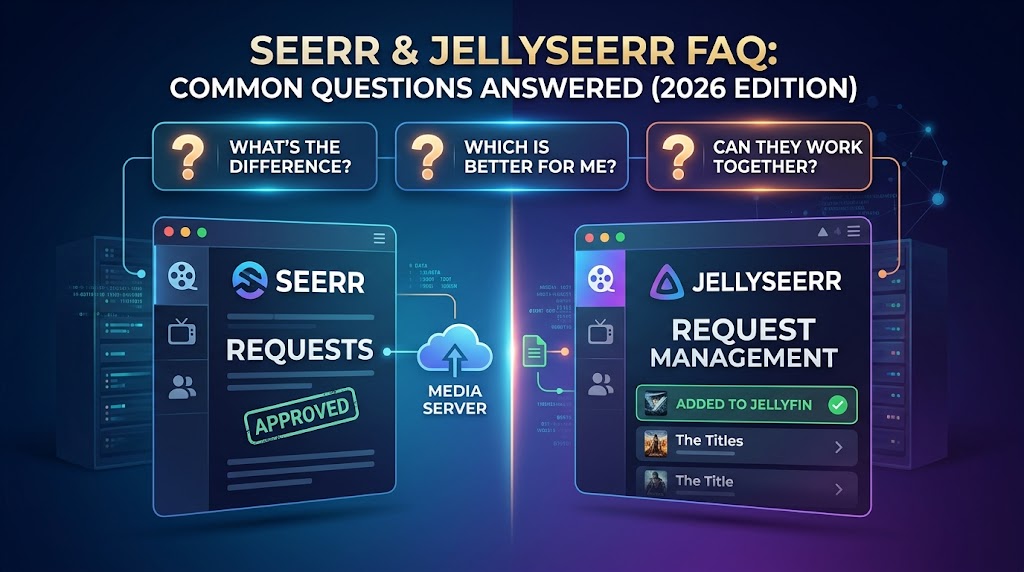
Seerr FAQ (2026): Jellyseerr and Overseerr Are Discontinued
If you run a request system for your Jellyfin or Emby server, here is the short version: Jellyseerr and Overseerr are both discontinued. Seerr is their official replacement, built by the same community to carry the project forward under a single name.
This is not a fork living alongside the old projects. Jellyseerr and Overseerr are no longer developed, no longer receive updates, and no longer receive security patches. Seerr is the continuation, not an alternative.
This FAQ answers the questions we see most often in the JellyWatch community and support channels about what this means for your server.
Wait, so Jellyseerr does not exist anymore?
Correct. Jellyseerr development has stopped. The project was retired and its functionality, its user base, and its future development all moved into Seerr. The same is true for Overseerr, the original tool Jellyseerr was forked from. Both are now legacy names for a project that continues exclusively as Seerr.
If you search for Jellyseerr today, you are looking for something that no longer receives any development. Seerr is not a competitor to Jellyseerr, it is what Jellyseerr became.
If Jellyseerr is discontinued, why does my instance still work?
Software does not stop running just because development stops. If you already have Jellyseerr installed, the container keeps working exactly as it did before. Nothing is remotely disabled. The issue is entirely forward looking: no new features, no bug fixes, and critically, no security patches for a tool that is typically exposed to the internet behind a reverse proxy.
Running a discontinued, internet facing tool indefinitely is a real risk, which is why migrating to Seerr should be a priority, not an eventually task.
Do I need to migrate right now?
There is no forced shutdown date, so your existing Jellyseerr or Overseerr instance will not stop working on its own. That said, treat this as urgent rather than optional. Every month you delay is a month without security fixes on a tool that talks directly to your Jellyfin or Emby server, and in most setups sits behind a reverse proxy exposed to the internet.
Will I lose my request history if I migrate?
No. Seerr performs an automatic migration on first startup when it detects an existing Jellyseerr or Overseerr configuration folder. Your users, request history, and settings are preserved. The only manual step is pointing Seerr at the same configuration volume your old container used.
Before migrating, always back up your appdata folder. This takes thirty seconds and gives you a safe rollback path if anything looks wrong after the first launch.
What is the Docker image name for Seerr?
The official image is:
ghcr.io/seerr-team/seerr:latest
Update your Docker Compose file or Unraid template to point at this image instead of the old Jellyseerr or Overseerr image, keeping the same volume mapping for /app/config.
My container keeps restarting after migration. What is wrong?
This is almost always a file permission issue. Seerr runs as UID 1000 inside the container. If your configuration folder is owned by a different user, the container will fail to write to it and restart in a loop.
Fix it with:
docker run --rm -v /path/to/appdata/config:/data alpine chown -R 1000:1000 /data
Then restart the container.
I get a blank page after updating. What now?
A blank page after an update is typically a stale browser cache issue. Hard refresh the page (Ctrl+Shift+R or Cmd+Shift+R) or clear the site cache for that domain. If the problem persists, check the container logs for a startup error before assuming the frontend is broken.
Does Seerr work with Emby?
Yes. Seerr keeps the same server integrations that Jellyseerr introduced, including native Jellyfin and Emby support, alongside the original Plex integration inherited from Overseerr.
Does Seerr work with Plex?
Yes. Plex support carried over directly from Overseerr, so if you run a mixed household with more than one media server, Seerr can still serve as your single request frontend.
My notifications stopped working after migration
Check your notification agent settings first (Discord webhook URL, email SMTP credentials, or your ntfy/Gotify endpoint). Migration preserves your configuration, but expired webhook URLs or rotated API tokens are a common cause of silent notification failures that have nothing to do with Seerr itself.
Quick feature comparison
| Feature | Overseerr | Jellyseerr | Seerr |
|---|---|---|---|
| Active development | No | No | Yes |
| Plex support | Yes | Yes | Yes |
| Jellyfin support | No | Yes | Yes |
| Emby support | No | Yes | Yes |
| Security updates | No | No | Yes |
| Automatic migration on first run | N/A | N/A | Yes |
How do I check which version I am running?
Open your request tool in a browser and check the bottom of the Settings > General page, or check the container image tag in your Docker Compose file or Unraid template. If the image still reads fallenbagel/jellyseerr or sctx/overseerr, you have not migrated yet.
Where can I get help if migration goes wrong?
The Seerr project maintains active support channels, and the wider self-hosting community on Reddit and Discord is generally quick to help with migration issues. If the problem is specifically about connecting Seerr to your Jellyfin server, our Jellyseerr to Seerr migration guide walks through Docker, Unraid, and Windows setups step by step.
Final thoughts
Seerr is a straightforward, low risk upgrade for anyone still running Jellyseerr or Overseerr. The migration is automatic, your data is preserved, and you gain active security maintenance in return. The only real prerequisite is a backup of your appdata folder before you start.
Manage your Seerr requests from your phone, without opening a browser. Download JellyWatch on Google Play - approve, reject, and track media requests natively on Android.

Comments
No comments yet. Be the first to share your thoughts.
Leave a comment