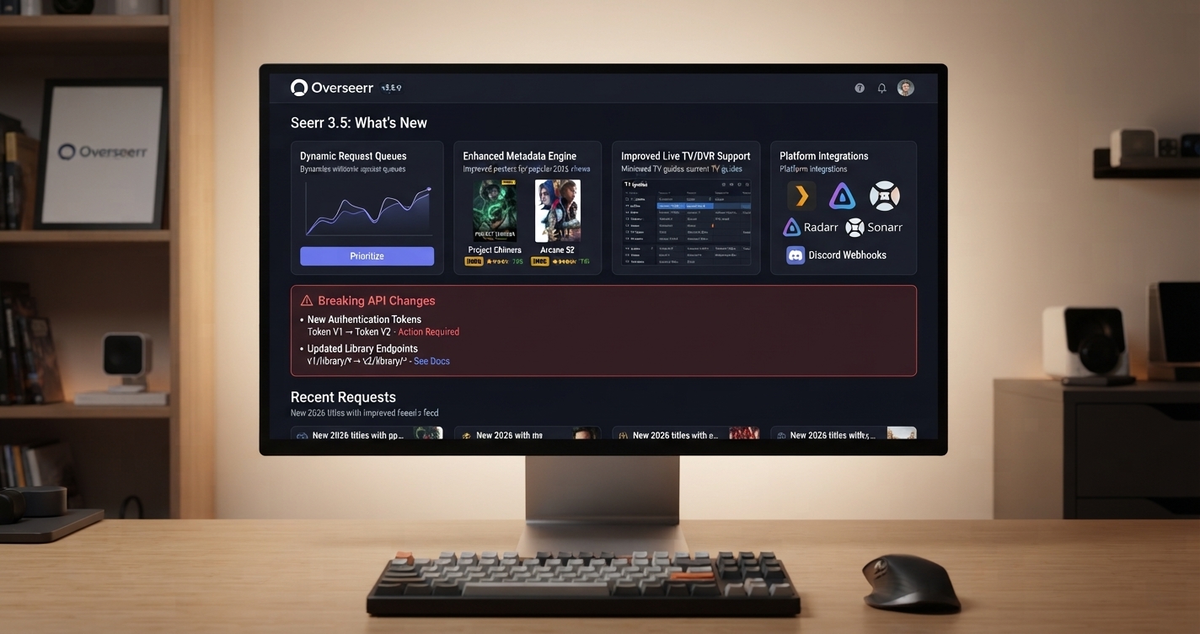
Seerr 3.5: What's New and the Breaking API Change You Need to Know About
Seerr 3.5.0 was released on September 28, 2026. It is a minor version by number, but it includes a change that can break scripts and third-party tools: the way Seerr's own Plex and Jellyfin library settings endpoints behave.
If you only use the web interface, the upgrade is routine. If you have anything that calls the Seerr API, read the next section first.
The Breaking Change: Library Endpoints
Before 3.5, two settings endpoints did double duty. A simple GET on the library list could also sync libraries or change which ones were enabled, through query parameters. That meant that reading libraries could change their state.
In 3.5, that is no longer true.
GET /settings/plex/libraryandGET /settings/jellyfin/libraryno longer accept thesyncorenablequery parameters.- Reading libraries no longer changes their enabled state.
Use these endpoints instead:
| Task | Old way | New way |
|---|---|---|
| Sync Plex libraries | GET /settings/plex/library with a sync parameter | POST /settings/plex/library/sync |
| Sync Jellyfin libraries | GET /settings/jellyfin/library with a sync parameter | POST /settings/jellyfin/library/sync |
| Enable or disable a Plex library | GET /settings/plex/library with an enable parameter | PUT /settings/plex/library/{libraryId} |
| Enable or disable a Jellyfin library | GET /settings/jellyfin/library with an enable parameter | PUT /settings/jellyfin/library/{libraryId} |
Check the Seerr API documentation for the exact request body each PUT expects.
The web interface already uses the new endpoints, so only direct API consumers are affected. The Seerr team shipped this in a minor release for that reason.
Who should check: anyone with automation that triggers library syncs, a dashboard or script that toggles libraries, or a third-party app that talks to Seerr settings. If you are not sure, search your scripts for settings/jellyfin/library and settings/plex/library.
New Features
- Hide already requested media. A new setting lets you hide titles that are already requested, which keeps the discover pages cleaner.
- User search. The user list has a search box, so you can find a person by username or email instead of scrolling.
- Override rules for advanced requests. Override rules are now applied to advanced requests too, not only standard ones.
- ntfy tags. Notifications sent through ntfy.sh can carry tags.
- Gotify poster option. Gotify notifications can embed the poster image.
- A Seerr user agent on outbound requests. Seerr now identifies itself when it calls other services, which helps when you read proxy logs.
- A demo feature.
- Custom Plex metadata provider GUID scheme support in the scanner.
If you use ntfy or Gotify, see our comparison of notification options for Jellyfin.
Fixes Worth Knowing About
The release has a long list of bug fixes. These are the ones most likely to matter in daily use.
Requests
- Requests for the same title are serialized, and request creation is serialized per user. This addresses cases where duplicate or conflicting requests could be created at the same time.
- Editing a request no longer re-requests seasons that are already covered, no longer takes a season that belongs to another request, and now enforces the user quota.
- Orphaned season statuses are reset when a request is deleted.
- Pending and failed states are enforced on the request routes.
- Requesting "all seasons" skips seasons that have no episodes, and phantom specials no longer block season requests.
- Download status on request cards is scoped to the seasons that were requested.
Jellyfin and Emby
- The authorization headers used for Jellyfin were updated.
- The avatar is refreshed when you sign in with Quick Connect.
- The Quick Connect button is hidden for Emby servers, since Emby does not offer it.
Sonarr and Radarr routing
- The configured series type is applied to non-anime requests.
- Anime root folder routing no longer depends on the series type.
- Override rules now match the default *arr server by its ID, and values set by advanced requesters are kept.
Database
- Leftover Overseerr
DELETEDstatus values are remapped after migration. - Several database issues on SQLite and Postgres were fixed, including timestamp handling and a stale unique constraint on push subscriptions.
Server
- The server now responds instead of hanging when a proxy route errors.
How to Upgrade
Back up your Seerr configuration directory first. Then pull the new image and recreate the container:
docker compose pull seerr
docker compose up -d seerr
Replace seerr with the name of your service if it is different. If you pin a tag, change it to 3.5.0 before pulling, or you will get the image you already have. The migration from older versions is automatic. For a fresh install, see our Seerr installation guide.
If you are still running Jellyseerr or Overseerr, those projects were merged into Seerr and are discontinued. Our migration guide and Seerr FAQ explain the move.
After Upgrading: A Short Checklist
- Open the web interface and confirm that your libraries are still enabled in Settings.
- Run a manual library sync once from the UI.
- Send a test notification if you use ntfy or Gotify.
- Check any scripts that call the settings API, using the table above.
- Request one title and confirm it reaches Sonarr or Radarr with the right root folder and series type.
Should You Upgrade Now?
For most people, yes. The fixes to request handling in particular reduce the chance of odd duplicate or lost requests, and the web UI needs no changes on your side. The only reason to wait is if you have API automation that you cannot update right away. In that case, update the scripts first, then upgrade.
Manage media requests from your phone. Download JellyWatch on Google Play to approve, reject and track requests natively on Android.
Sources: Seerr 3.5.0 release notes on GitHub. Content was rephrased for compliance with licensing restrictions.



Comments
No comments yet. Be the first to share your thoughts.
Leave a comment