
Jellyfin Surpasses Plex: The Self-Hosting Shift of 2026
Something remarkable happened in the self-hosted media server space. According to the r/selfhosted community survey of over 2,100 respondents, Jellyfin claimed 51.2% of the self-hosted media server market in 2024 - surpassing Plex for the first time among homelab enthusiasts.
This is not a minor fluctuation. It represents a fundamental shift in how the self-hosting community thinks about media servers.
The Numbers
| Platform | Market share (2024 survey) |
|---|---|
| Jellyfin | 51.2% |
| Plex | ~40% |
| Emby | ~8% |
The same survey found that 84.2% of deployments run on Linux, confirming that the self-hosting community overwhelmingly favors open-source infrastructure.
Why Jellyfin Won
1. Zero Cost, Forever
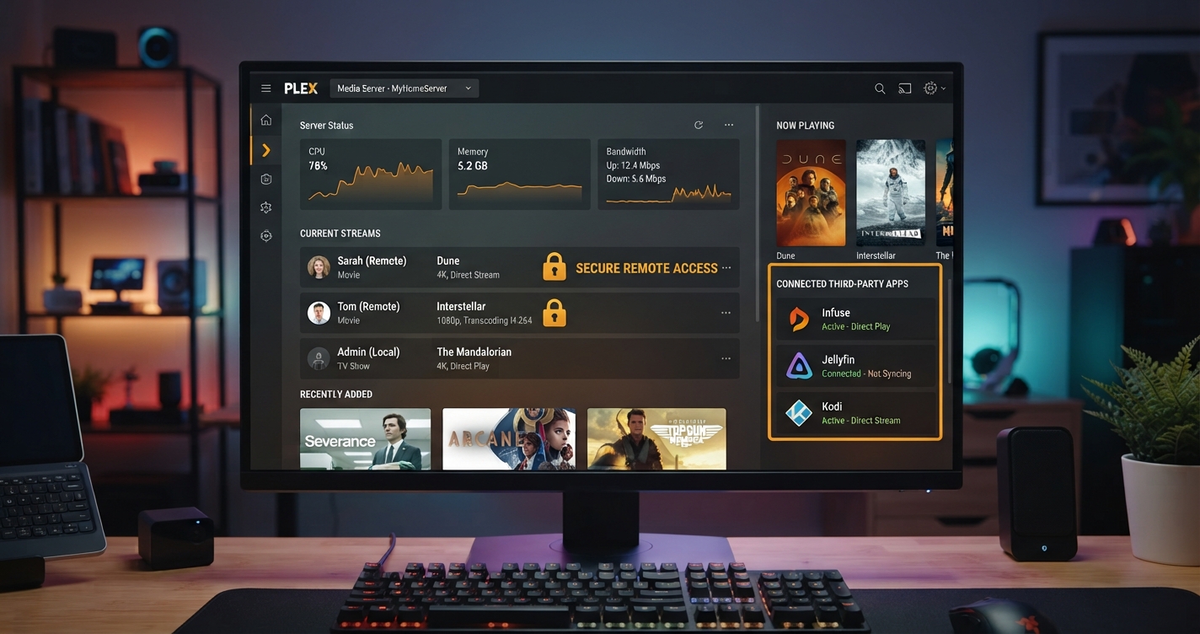
Jellyfin has no premium tier. Every feature - hardware transcoding, Live TV, mobile apps, multi-user - is free. Plex locks these behind Plex Pass ($4.99/month or $119 lifetime).
For a community that self-hosts specifically to avoid subscriptions, this matters enormously.
2. No Account Required
Plex requires a Plex account and routes authentication through Plex servers. If Plex's cloud goes down, you cannot access your own server. This has happened multiple times, and each incident pushes users toward Jellyfin.
Jellyfin requires zero external accounts. Your server, your authentication, your data.
3. No Ads, No "Discover" Tab
Plex has increasingly pushed free ad-supported content, a "Discover" tab, and streaming recommendations into the interface. For users who built a media server to escape exactly this, it feels like a betrayal.
Jellyfin shows your content and nothing else.
4. The Plugin Ecosystem Exploded
Jellyfin's open API and plugin system attracted a massive wave of community development. In 2026, there are over 70 third-party clients and dozens of plugins covering everything from anime metadata to Discord notifications.
The Intro Skipper plugin alone - giving Netflix-style skip buttons - was a killer feature that Plex still does not match natively.
5. Hardware Got Cheap
The Intel N100 mini PC revolution made powerful Jellyfin servers available for $130. A silent, 10W device that handles 4 simultaneous 4K transcodes eliminated the "Jellyfin needs expensive hardware" argument.
6. Docker Made Setup Easy
The self-hosting renaissance of 2025-2026 was fueled by Docker Compose making complex stacks trivial to deploy. A complete Jellyfin + Radarr + Sonarr + Jellyseerr stack deploys in minutes with a single docker compose up -d.
What This Means for the Ecosystem
For Jellyfin
More users means more contributors, more plugins, more clients, and faster development. Jellyfin 10.11's EF Core migration and built-in backup support show a project that is maturing rapidly.
For Plex
Plex is not dying - it still dominates among casual users who want zero-configuration streaming. But in the self-hosting community specifically, the trend is clear.
Plex's response has been to double down on its cloud ecosystem, ad-supported content, and rental marketplace - features that appeal to mainstream users but alienate the self-hosting core.
For Emby
Emby holds steady at ~8% but faces pressure from both sides. Jellyfin offers the same features for free; Plex offers a more polished experience. Emby's niche is users who want a middle ground with official support.
The Companion App Ecosystem
One area where Jellyfin lagged behind Plex was mobile admin tools. Plex had Tautulli; Jellyfin had nothing comparable.
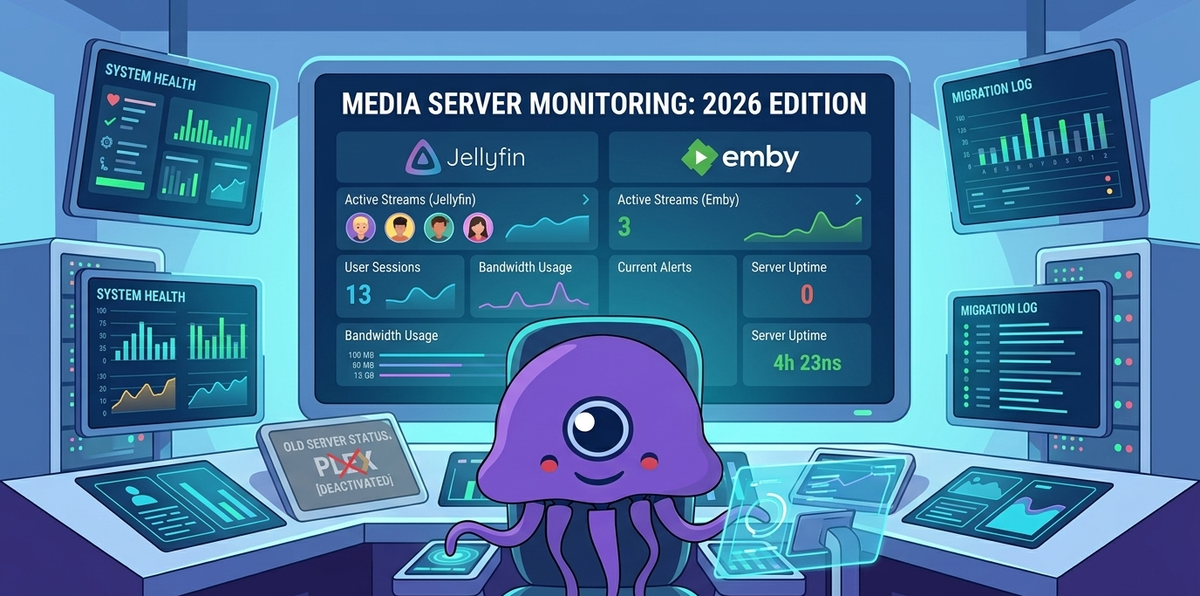
JellyWatch filled this gap - providing real-time session monitoring, push notifications, Radarr/Sonarr/Jellyseerr integration, and server health tracking in a native Android app. For Emby users, EmbyWatch provides the same experience.
The availability of dedicated admin tools was one of the final barriers to Jellyfin adoption for serious server administrators.
Is 2026 the Right Time to Switch?
If you are on Plex
Yes. Jellyfin 10.11 is the most stable and feature-complete release ever. The migration path is well-documented (Trakt sync for watch history, same media files, same folder structure). You lose Plex's cloud relay but gain privacy, freedom, and zero cost.
If you are on Emby
The switch is even easier - Jellyfin forked from Emby, so the architecture is similar. Your media files work identically.
If you are starting fresh
Jellyfin is the obvious choice in 2026. Free, open source, massive community, excellent hardware support, and a mature plugin ecosystem.
FAQ
Is Jellyfin really better than Plex now? For self-hosters who value privacy, cost, and control - yes. For casual users who want plug-and-play with zero configuration - Plex is still easier.
Will Plex become irrelevant? No. Plex serves a different audience (mainstream, cloud-first). But in the self-hosting niche, Jellyfin is now the default.
Is Jellyfin stable enough for a family server? Absolutely. Jellyfin 10.11 with an Intel N100 mini PC is rock-solid for family use.
What about Emby? Emby is a fine product but struggles to justify its Premiere pricing when Jellyfin offers the same features for free.
Join the 51%. Start monitoring your Jellyfin server like a pro. Download JellyWatch on Google Play - the admin companion app that Plex users wish they had.
On Emby? Download EmbyWatch on Google Play - the same monitoring experience for Emby servers.


Comments 3
51% market share is incredible for an open-source project with zero marketing budget. The community built this.
The N100 mini PC revolution + Docker Compose simplicity made Jellyfin accessible to everyone. That's why it won.
Plex pushing ads into my personal library was the last straw. Jellyfin shows MY content and nothing else. As it should be.
Leave a comment