Jellyfin 10.11 EF Core Migration: What Really Happened
When Jellyfin 10.11.0 dropped in October 2025, it carried the biggest backend change in the project's history: a complete database overhaul replacing raw SQLite calls with Entity Framework Core (EF Core). The promise was faster queries, a unified database, and a path toward PostgreSQL support.
What followed was one of the most turbulent upgrade cycles the Jellyfin community has ever experienced.
This article documents what actually happened - based on hundreds of forum threads, GitHub issues, and the official "State of the Fin" post from January 2026 - and what every Jellyfin admin should know before upgrading.
What Changed in 10.11
Prior to 10.11, Jellyfin used multiple SQLite database files:
library.db- all media metadatajellyfin.db- users, authentication, settings- Several plugin-specific databases
Version 10.11 consolidated everything into a single jellyfin.db managed by EF Core. This migration ran automatically on first startup - and for many users, it did not go smoothly.
The Problems That Hit the Community
1. Migration Failures (GitHub #15027, #15060)
The most severe issue: the migration process itself failed for a significant number of users. Common symptoms:
- Server stuck at startup for hours with no progress
- Log messages showing migration errors mid-process
- Server refusing to start after a failed migration attempt
- Database left in a partially migrated, corrupted state
Users who had not backed up their config before upgrading lost their entire watch history and metadata.
2. Catastrophic Performance Regression
Even for users who migrated successfully, the performance impact was severe:
- Collections library: 10-15 seconds to load (previously instant)
- Large movie libraries: 30-50 seconds on the home page
- Home Videos libraries with 16,000+ items: would not load at all
- Library scans: caused the entire UI to become unresponsive
One user on the forum described it bluntly:
"10.10 and under were fast and awesome. Once my install was corrupted by the 10.11 upgrade I had to wipe and do a fresh install at 10.11.1 and it's working again but so slow and laggy - it literally breaks the UI as in it will not load until a scan is done."
The root cause was client-side enumeration - EF Core was loading entire datasets into memory and filtering them in application code rather than pushing filters down to the database engine. For large libraries, this meant loading tens of thousands of records into RAM on every page request.
3. Broken Home Videos Library Type
The "Home Videos" library type was effectively broken in 10.11.0 and 10.11.2:
- Infinite loading or no load at all
- Items not displaying correctly
- No shuffle or play-all option
- Subfolders not shown when nested folders were used
For users with large personal video archives, this was a dealbreaker. Several reverted to 10.10.7.
4. Slow Playlist Loading
Users with large playlists (500+ items) reported that playlist loading degraded from under a second to 30+ seconds. The issue was consistent across all 10.11.x releases through early 2026.
The Team's Response
To their credit, the Jellyfin team moved quickly. From the official State of the Fin (January 2026):
"We have been moving quickly to address these issues, delivering four additional point releases with over 100 changes since the initial 10.11.0 release."
By 10.11.5 (March 2026), most migration and general bugs were resolved. Performance issues caused by client-side enumeration were still being investigated.
Timeline of fixes
| Version | Key fixes |
|---|---|
| 10.11.1 | Migration bug fixes, startup failures |
| 10.11.2 | Performance improvements, partial Home Videos fix |
| 10.11.3 | General stability, watched status fixes |
| 10.11.4 | Metadata display, music issues |
| 10.11.5 | Xbox TV mode, additional stability |
| 10.11.7 | 4 critical security fixes + 25 bug fixes |
Why Did This Happen?
The Jellyfin team acknowledged the situation directly. The EF Core migration had been in development since 2019 - six years of incremental work by volunteer contributors. The final push involved:
- 6+ months of active development
- 6 months of release candidate testing
- A limited pool of RC testers compared to the full user base
The scale of the change meant that edge cases only surfaced at production scale. Libraries with unusual structures (deeply nested folders, Home Videos with thousands of items, large playlists) hit code paths that RC testing had not covered.
The Versioning Debate
The 10.11 release triggered a broader community discussion about Jellyfin's versioning scheme. Many users expected a "minor" version bump (10.10 → 10.11) to be a safe, incremental update. Instead, it was the most disruptive release in years.
From the State of the Fin:
"We received a substantial amount of feedback regarding our versioning scheme following the 10.11 release, particularly concerning the stability of what are perceived as 'minor' version updates. This has prompted internal discussions about potentially revising our versioning scheme in the next major release. While nothing has been finalized yet, we are considering 'dropping' the major version 10, which would make the next release 12.0."
This would align Jellyfin's versioning with the actual impact of its releases - a 12.0 label would correctly signal "this is a major change, back up before upgrading."
What This Means for PostgreSQL Support
The EF Core migration was not just about performance - it was the prerequisite for external database support. With EF Core managing all database interactions, adding a PostgreSQL backend becomes architecturally possible.
As of early 2026, PostgreSQL support is on the roadmap but not yet implemented. The community discussion on the Jellyfin forum has been active, with users asking about MySQL/MariaDB support as well. The team's position: EF Core opens the door, but the actual implementation requires additional work.
Lessons for Jellyfin Admins
Before any major Jellyfin upgrade:
- Always back up your
/configfolder - this is non-negotiable after 10.11 - Read the release notes - "minor" version bumps can contain major changes
- Wait for the first point release - 10.11.1 fixed the worst migration issues
- Test on a non-production instance first if you have a large or unusual library
- Monitor the first startup - the migration can take 5-15 minutes on large libraries
If you hit migration issues:
- Do not restart the server mid-migration
- Check GitHub issues #15027, #15060, and the group issue #15686 for your specific error
- Restore from backup and upgrade to the latest point release instead of 10.11.0
The Silver Lining
Despite the rough launch, the EF Core migration is genuinely the right long-term move. The unified database simplifies backups, enables future features, and lays the groundwork for PostgreSQL. By 10.11.5+, most users report a stable experience.
The community's response - detailed bug reports, patient testing, and constructive feedback on versioning - helped the team ship fixes faster than any previous release cycle.
Jellyfin 10.11 was painful. It was also necessary.
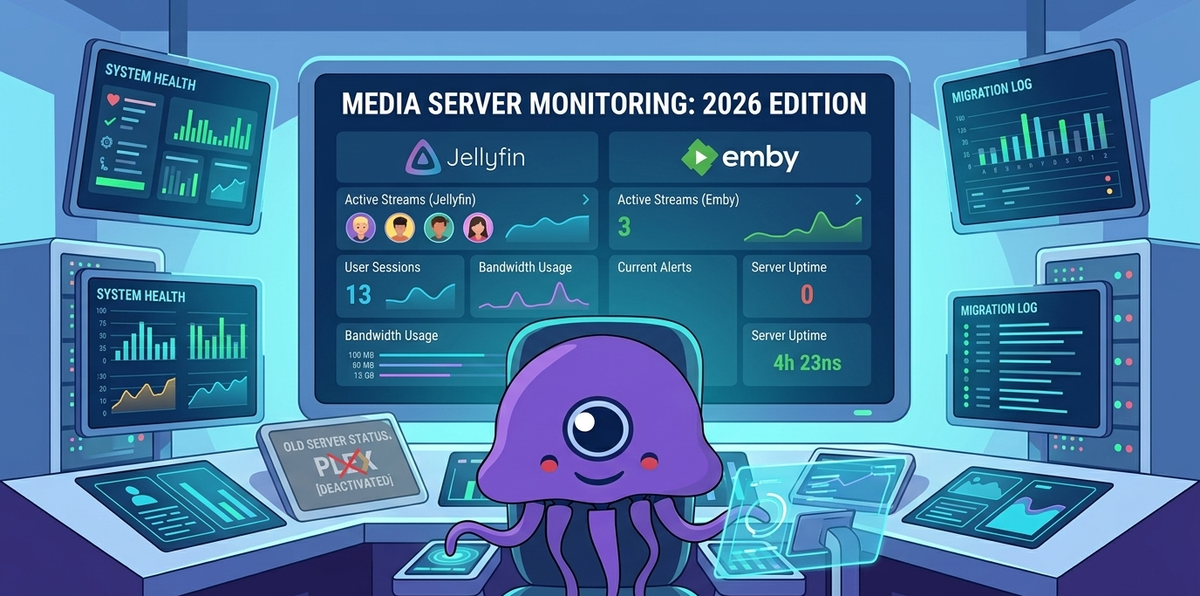
Upgrading to Jellyfin 10.11? Monitor your server through the migration. Download JellyWatch on Google Play - real-time server health, CPU monitoring, and session tracking to verify your upgrade went smoothly.


Comments
No comments yet. Be the first to share your thoughts.
Leave a comment